- +91 9497439422
- nicheplanters@gmail.com
- Mon-Sat: 10:00 AM - 7:00 PM


Published on September 23, 2026 | By Niche Group
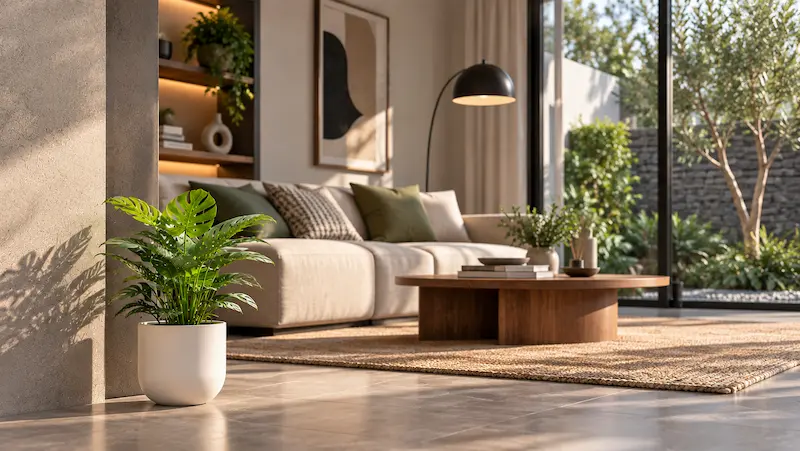
Contemporary interiors have quietly rewritten the rules of home décor. Ornamentation has given way to restraint, heavy embellishment to honest geometry, and clutter to calm, deliberate space. In this new visual language, the planter is no longer a background object- it is a design statement. FRP planters, crafted from fibreglass-reinforced plastic, have become the material of choice for architects and interior stylists who want sculptural form, weather resilience, and effortless scale in a single product. For a home that speaks in clean lines and quiet confidence, the right pot is not an accessory. It is architecture at floor level.
Modern design is defined less by what it adds and more by what it removes. A contemporary FRP planter carries no fussy moulding, no imitation carving, no visual noise. Its surface is smooth and matte or subtly satin, its silhouette crisp, and its proportions intentional. Leading FRP planter manufacturers achieve this through precision moulding, which allows a single seamless shell with uniform thickness and no visible joints.
Fibreglass-reinforced plastic is uniquely suited to this aesthetic. Unlike terracotta or concrete, it can be cast into sharp, thin-edged forms without cracking, and it holds a flawless finish across large surfaces. It is also remarkably light relative to its strength, which means a planter can be generously sized without demanding structural reinforcement beneath it. For a manufacturer, the discipline lies in consistency- every unit matching the approved sample in colour, sheen, and dimension.
Minimalist homes are not empty homes; they are edited homes. Every object earns its place. FRP planters fit this philosophy because they perform multiple roles at once. A tall cylindrical planter can act as a natural room divider without the weight of a wall. A low, wide bowl can anchor a seating zone. A matched pair can frame an entryway with quiet symmetry.
Smart-home design adds another layer. Automated irrigation, concealed drip lines, and integrated lighting all require planters that can be drilled, routed, and fitted without compromising their structure. FRP accepts clean, precise modifications far more gracefully than brittle materials, and its non-porous surface resists moisture and staining. The result is greenery that stays lush with minimal human intervention- exactly the low-effort, high-order aesthetic that modern living demands.
Shape is where minimalist design becomes expressive. Three families dominate contemporary interiors:
Because FRP is moulded rather than thrown or carved, a manufacturer can produce these forms at almost any scale- from a tabletop piece to a jumbo planter that defines an entire courtyard.
Colour in minimalist design behaves like silence in music: it sets the tone. Whites make a space feel larger and lighter, and they allow foliage to become the hero. Soft greys bridge warm wood and cool stone, offering a sophisticated middle ground. Deep blacks and charcoal shades add weight and definition, grounding airy rooms and making green leaves appear more vivid.
FRP holds pigment evenly throughout its surface and accepts high-quality gel-coat finishes, so whites stay white and blacks stay deep rather than fading unevenly in strong sunlight. This colour stability is a genuine advantage in Kerala, Tamil Nadu, Karnataka, Andhra Pradesh, and Telangana, where intense UV exposure quickly dulls inferior finishes. A neutral palette also future-proofs a purchase: a white or grey planter moves seamlessly between rooms, seasons, and redecorating cycles.
Pure minimalism can feel cold. Most real homes are mixed-style spaces- a contemporary sofa beside an heirloom wooden cabinet, a sleek planter near a handwoven textile. FRP planters integrate gracefully into this balance because they are visually quiet but materially warm when finished in textured or stone-effect surfaces.
The trick is contrast. Place a smooth, matte-black FRP planter against a rustic wall and it sharpens the texture. Set a soft grey cylindrical pot beside cane furniture and it modernises without competing. In mixed-style interiors, planters act as translators, linking old and new, indoor and outdoor, hard surfaces and living greenery.
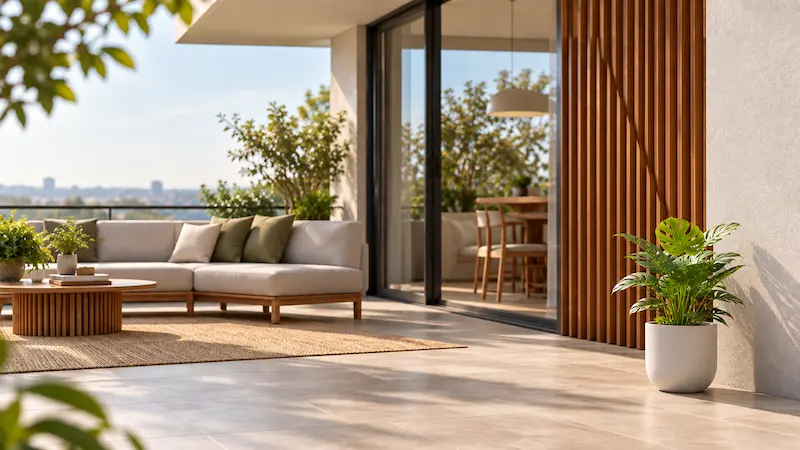
Modern design increasingly means responsible design. FRP planters support sustainability on several fronts. Their durability- often a decade or more of outdoor service- means fewer replacements and less waste than short-lived alternatives. Their light weight reduces transport emissions and structural material use. Their non-porous surface needs less water retention management and no chemical sealing.
The most forward-looking FRP planter manufacturers are also exploring recycled filler materials, low-VOC resins, and repairable finishes that extend product life. For buyers, the sustainable choice is often the simplest: select a planter sized for the mature plant, choose a neutral colour that will not date, and invest once in quality that lasts.
At Niche Group, a Trivandrum-based manufacturer and supplier serving Kerala, Tamil Nadu, Karnataka, Andhra Pradesh, and Telangana, modern FRP planters are designed as long-term architectural elements rather than disposable décor. From jumbo planters and fountains to sculptural forms and outdoor FRP benches, the focus stays on clean lines, durable finishes, and forms that let contemporary homes breathe.
Minimalism, ultimately, is not about having less. It is about choosing better and a well-made FRP planter, quietly holding its ground and its greenery, is exactly that kind of choice.