- +91 9497439422
- nicheplanters@gmail.com
- Mon-Sat: 10:00 AM - 7:00 PM


Published on September 22, 2026 | By Niche Group
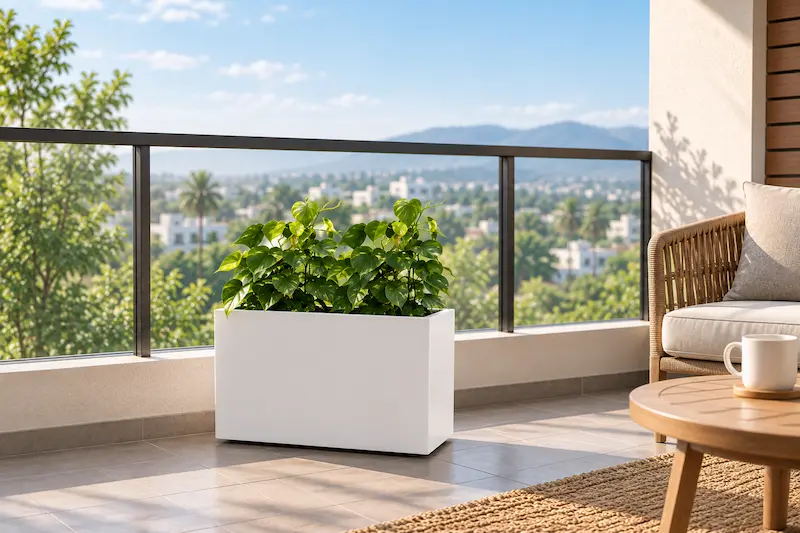
A balcony is often the only open sky an apartment dweller gets, and it deserves more than a drying rack. With the right container, even four or five square feet can hold herbs for the kitchen, flowers for the eye, and a chair to sit and enjoy them. FRP planters have quietly become the go-to choice for this kind of gardening, because they solve the two problems that defeat most small-space gardeners: weight and weather. This guide walks through what to look for, what to grow, and how to do it safely.
FRP, or Fibre Reinforced Plastic, is a composite of glass fibre and resin that is moulded into shape rather than thrown on a wheel. That single fact changes what a planter can be. Instead of a heavy round pot, you get slim troughs that hug a wall, tall columns that take up little floor area, shallow bowls for shallow-rooted herbs, and curved planters that fit the odd corners of a modern balcony. FRP planters also hold their colour and shape through Kerala's monsoon humidity and the punishing summer sun, unlike terracotta that chips or cement that stains. They do not absorb moisture, so the soil dries at a predictable rate, which matters when a plant is sitting in a shallow container on a hot afternoon. The result is a balcony that looks designed rather than crowded, because the planters themselves can be shaped around the space instead of the other way around.
A balcony slab is engineered for people, furniture, and the occasional party, not for tonnes of wet soil. A large terracotta or cement planter filled with damp potting mix can weigh far more than a person standing beside it, and that load concentrates on a small footprint. FRP planters are dramatically lighter for the same volume, so you can garden generously without pushing the slab toward its limits. The practical benefit is mobility: you can shift a planter into the shade during peak summer, move it under cover before a storm, or rearrange the whole balcony when you want a change. Anyone who has tried to drag a wet cement pot across tiles will understand why this matters. Lightweight also means a single person can install a large planter without help, which keeps a small project genuinely small.
When floor space runs out, the wall becomes the garden. FRP is easy to mould into wall-mounted pockets, tiered stands, and stackable modules, and it is light enough that fixing a row of planters to a parapet or wall does not demand heavy structural work. This is where working with an experienced FRP planter manufacturer pays off. A good manufacturer can build planters to the dimensions of your balcony, add concealed drainage, and match a finish to the building's facade. Niche Group, a Trivandrum-based manufacturer and seller of FRP planters, fountains, carpets, and outdoor FRP benches, customises pieces from its base in Kerala and serves customers across Kerala, Tamil Nadu, Karnataka, Andhra Pradesh, and Telangana.
FRP planters suit almost any small plant, but a few groups are reliably rewarding. Herbs are the easiest win: mint, coriander, curry leaf, basil, and lemongrass all thrive in containers and give something back every week. Flowers such as bougainvillea, marigold, portulaca, and petunia add colour and handle Indian heat well. For vegetables, stick to compact varieties: chillies, dwarf tomatoes, spinach, lettuce, and fenugreek. The one rule that matters more than the plant choice is drainage. Whatever you grow, use a light potting mix rather than garden soil, and never let water sit in the base of the planter.
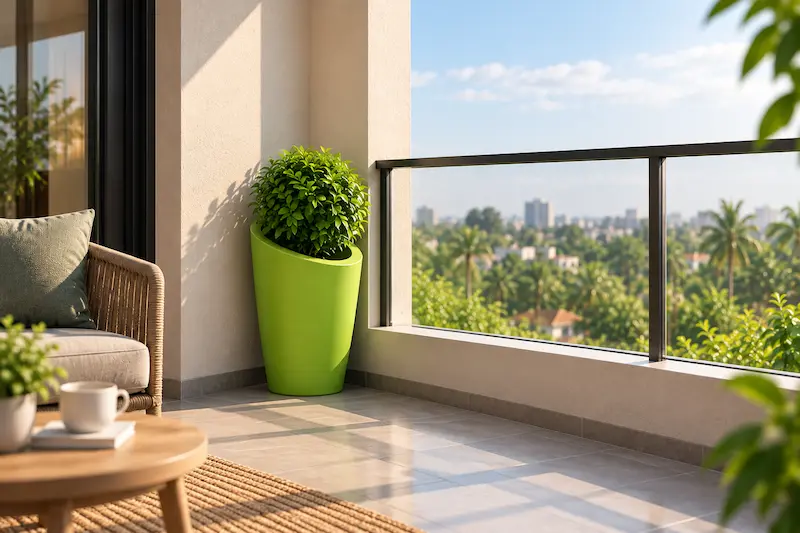
Two spots on almost every balcony go unused: the railing and the corner. Railing-mounted FRP planters turn the top of the parapet into a row of greenery without consuming a single square foot of floor, and they are light enough to hang securely. Corner planters, often tall and column-shaped, fill the awkward junction where two walls meet and can double as a screen for a water tank or drainpipe. Together, these two types can add more growing space than the open floor of a small balcony holds, which is why they are the first upgrade most balcony gardeners make. If you are unsure what will fit, measure the railing span and the corner width before ordering, and let the manufacturer shape the planter to those numbers.
Before you buy, think about the building, not just the plant. Distribute weight evenly rather than clustering heavy planters in one corner, and keep tall planters away from the outer edge where wind catches them. Check that your apartment association permits railing-mounted planters, since some buildings restrict anything fixed to the parapet. Choose planters with proper drainage holes and a saucer or tray to protect the floor below from staining, and anchor tall or stacked units so a gust during the monsoon cannot topple them. A well-made FRP planter from a reputable manufacturer, backed by standard warranty and quality norms, is a far safer bet than a cheap imitation that cracks in a season.
A balcony garden does not need a big budget or a big space. It needs containers that are light, weatherproof, and shaped for the room you actually have. FRP planters deliver all three, and choosing them well is the difference between a balcony that looks cluttered and one that feels like a small, green retreat.